

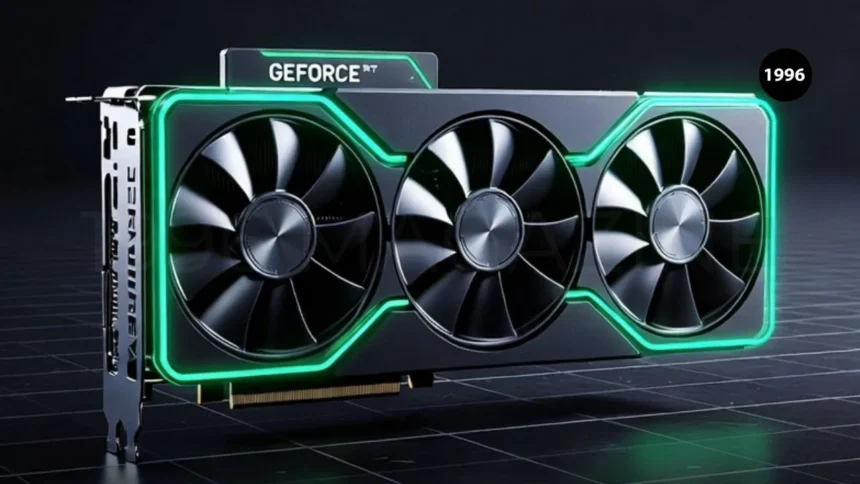
The NVIDIA GeForce RTX 5090 stands as the flagship of the Blackwell series and represents a significant leap in consumer graphics technology in 2026. With its massive core count, enormous memory bandwidth, and advanced AI capabilities, many experts consider it the most powerful consumer GPU ever released.
This article explores why the RTX 5090 earns this title. You will discover its groundbreaking specifications, real-world performance advantages, revolutionary DLSS 4 features, power and cooling demands, pricing realities, and practical implications for gamers, creators, and AI enthusiasts. We examine how the card pushes boundaries in 4K and 8K gaming, ray tracing, content creation, and local AI workloads while addressing potential drawbacks and who should consider upgrading in 2026.
Quick Specs Overview
| Specification | RTX 5090 (Blackwell) | RTX 4090 (Ada Lovelace) |
|---|---|---|
| CUDA Cores | 21,760 | 16,384 |
| VRAM | 32GB GDDR7 | 24GB GDDR6X |
| Memory Bandwidth | 1,792 GB/s | 1,008 GB/s |
| AI TOPS | 3,352 | ~1,321 |
| TGP (Total Graphics Power) | 575W | 450W |
| Launch MSRP | $1,999 | $1,599 |
| Architecture | Blackwell GB202 | Ada Lovelace AD102 |
Unprecedented Core Count and Architecture
The RTX 5090 features 21,760 CUDA cores on the new Blackwell GB202 GPU, built on a refined 4nm process. This represents a substantial increase over the RTX 4090’s 16,384 cores. The architecture introduces fifth-generation Tensor Cores and fourth-generation RT Cores that handle complex calculations far more efficiently.
These hardware improvements allow the card to process vastly more operations per second. In practical terms, the RTX 5090 delivers higher base performance even before enabling AI features. The design also includes an AI Management Processor that runs multiple neural networks simultaneously without impacting gaming or rendering tasks. This level of raw compute power positions the RTX 5090 as a true flagship that redefines what a consumer graphics card can achieve.
Massive Memory and Bandwidth Advantages
With 32GB of high-speed GDDR7 memory and an incredible 1,792 GB/s bandwidth, the RTX 5090 handles large datasets and high-resolution textures effortlessly. This generous VRAM becomes especially valuable for 8K gaming, complex 3D scenes, and local AI model inference.
Compared to the RTX 4090’s 24GB GDDR6X, the jump in both capacity and speed reduces stuttering in memory-intensive scenarios. Content creators working with 8K video timelines or large AI-generated assets notice significantly smoother workflows. The combination of high memory capacity and bandwidth makes the RTX 5090 exceptionally future-proof for the increasingly demanding applications expected throughout the late 2020s.
DLSS 4 and Multi Frame Generation Revolution
DLSS 4 with Multi Frame Generation stands as one of the biggest reasons the RTX 5090 feels like the most powerful consumer GPU ever. The transformer-based AI model delivers sharper upscaled images and generates multiple additional frames from a single rendered frame with minimal latency.
In real-world tests, this technology allows the card to achieve frame rates that were previously impossible at maximum settings with full ray tracing. Games that struggled to maintain 60 FPS at 4K on the previous generation now run smoothly at 100+ FPS with excellent image quality. The AI enhancements also improve ray reconstruction and neural shaders, creating more realistic lighting and materials while maintaining high performance.
Ray Tracing and Neural Rendering Capabilities
The fourth-generation RT Cores in the RTX 5090 handle mega geometry and complex ray-traced scenes with greater efficiency. Combined with Ray Reconstruction, the card produces cleaner, more accurate global illumination and reflections. Neural shaders further enhance realism by applying AI directly to materials and lighting in real time.
These advancements result in visuals that approach cinematic quality in supported titles. The RTX 5090 makes full path tracing playable at high resolutions for the first time on consumer hardware. This combination of raw power and intelligent AI processing gives the card a clear edge over previous generations and competing solutions in visual fidelity.
Performance in Gaming and Content Creation
Benchmarks in 2026 show the RTX 5090 delivering 30–50% higher performance than the RTX 4090 in most modern titles, with even larger gains when ray tracing and DLSS 4 are enabled. At 4K with maximum settings, the card consistently provides smooth, high-refresh-rate gameplay.
Content creators benefit from faster rendering times, real-time previews, and accelerated AI tools. Video editors, 3D artists, and AI researchers appreciate the 32GB VRAM and high tensor performance for handling large projects locally. The RTX 5090 excels in both traditional rasterization and cutting-edge AI-accelerated workflows, making it a versatile powerhouse for professional use.
Power Consumption and Cooling Challenges
The RTX 5090 has a 575W Total Graphics Power rating, noticeably higher than the RTX 4090. In demanding scenarios, actual consumption can approach or exceed 550W. This requires a robust power supply — NVIDIA recommends at least 1000W for system stability.
Cooling solutions vary by model. The Founders Edition uses advanced thermal materials and maintains reasonable temperatures and noise levels. Partner cards often feature larger coolers or liquid cooling options for enthusiasts seeking maximum overclocking or quieter operation. Proper case airflow remains essential to prevent thermal throttling during extended sessions.
Pricing and Market Position in 2026
NVIDIA launched the RTX 5090 at a $1,999 MSRP. However, due to high demand and memory shortages, real-world prices in 2026 often range from $2,800 to over $4,000 depending on the model and availability. Premium custom versions command even higher premiums.
Despite the cost, the card’s unmatched performance and future-proof features justify the investment for users who demand the absolute best. NVIDIA positioned the RTX 5090 as the ultimate enthusiast and professional solution, targeting those who prioritize performance over budget constraints.
Who Should Consider the RTX 5090?
Enthusiasts building ultimate 4K or 8K gaming rigs will appreciate the card’s capabilities the most. Content creators working with high-resolution video, complex 3D renders, or local AI models benefit greatly from the VRAM and compute power. Professionals running demanding simulations or AI inference tasks also find strong value here.
Users with RTX 4090 systems may wait for further price stabilization or a potential Ti variant later in 2026. Gamers on 1440p or lower resolutions might find better value in mid-range RTX 50-series cards. The RTX 5090 shines brightest for those who can fully utilize its advanced features and are willing to invest in supporting hardware.
Potential Limitations and Considerations
High power draw increases electricity costs and heat output. Supply constraints and scalper pricing can make acquisition challenging and expensive. Not all games immediately support the full suite of DLSS 4 features, though adoption continues to grow rapidly.
The significant cost means the upgrade only makes sense if you actively use the additional performance. For many users, the RTX 5090 represents overkill rather than necessity. Careful evaluation of your specific needs and budget remains important before purchasing.
Future Outlook for the RTX 5090
As game engines and AI tools continue evolving, the RTX 5090’s hardware advantages and DLSS 4 capabilities will become even more valuable. Regular driver updates will unlock further performance and feature improvements throughout 2026 and beyond. The card’s generous VRAM and AI compute power position it well for emerging technologies like advanced neural rendering and real-time AI assistants in games.
NVIDIA’s strong software ecosystem ensures the RTX 5090 remains relevant for several years. For users seeking the pinnacle of consumer graphics in 2026, this card delivers an experience that truly feels like the most powerful GPU ever made for personal computers.
Conclusion
The NVIDIA GeForce RTX 5090 earns its reputation as potentially the most powerful consumer GPU ever through a combination of raw hardware muscle, revolutionary AI features like DLSS 4 with Multi Frame Generation, massive memory capacity, and exceptional performance across gaming and professional workloads. While it demands significant investment in power, cooling, and budget, the card delivers unmatched capabilities that push the boundaries of what’s possible in 2026.
For enthusiasts, creators, and power users who want the absolute best, the RTX 5090 offers a compelling upgrade that will remain relevant for years to come. Its blend of brute force and intelligent AI acceleration sets a new standard for consumer graphics cards and solidifies NVIDIA’s leadership in the high-end GPU market.
Frequently Asked Questions
Why is the RTX 5090 considered the most powerful consumer GPU ever?
It combines the highest core count, 32GB GDDR7 memory, record AI performance, and DLSS 4 with Multi Frame Generation, delivering unmatched results in gaming, ray tracing, and AI workloads.
How much more powerful is the RTX 5090 than the RTX 4090?
The RTX 5090 offers 30–50% higher performance in most scenarios, with even larger gains when using DLSS 4 and ray tracing. The difference becomes most noticeable at 4K and above.
Does the RTX 5090 require a special power supply?
Yes. NVIDIA recommends at least a 1000W PSU due to the 575W TGP. A high-quality unit with proper headroom ensures stability.
Is the RTX 5090 worth the high price in 2026?
It depends on your needs. For users who fully utilize its AI features, high-resolution gaming, or professional workloads, the performance justifies the cost. Others may find better value in lower-tier models.
How does DLSS 4 contribute to the RTX 5090’s power?
DLSS 4 with Multi Frame Generation dramatically increases frame rates while maintaining excellent image quality, effectively making the GPU perform far beyond its raw hardware specifications.
Will the RTX 5090 remain relevant for several years?
Yes. Its generous VRAM, advanced AI capabilities, and strong software support position it as a future-proof card for demanding applications well into the late 2020s.
Stay More Update: 1996 Magazine