

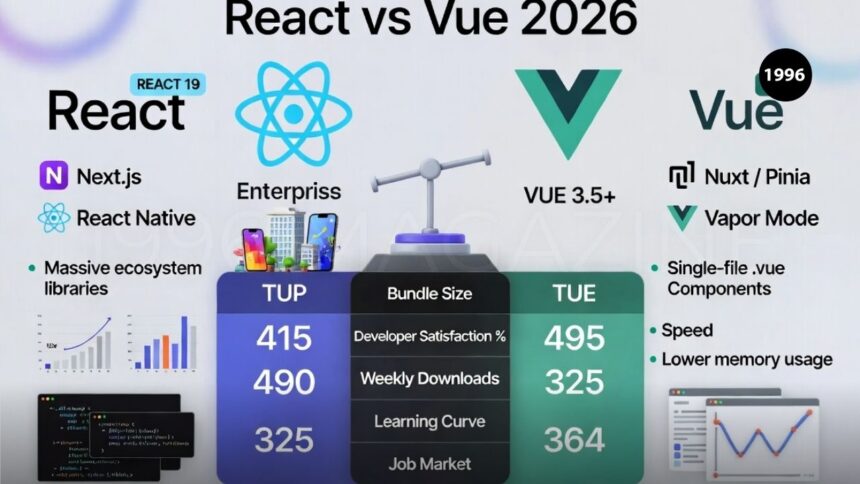
React and Vue remain the two dominant forces in frontend development as we move through 2026. React, backed by Meta, continues to lead in adoption, ecosystem size, and job market demand. Vue, created by Evan You and driven by a passionate community, stands out for its exceptional developer experience, progressive nature, and strong satisfaction ratings among users. In 2026, React 19 brings stable Server Components, a new compiler for automatic optimizations, and enhanced Actions for better form handling.
Vue 3.5 (with previews of 3.6 features like Vapor Mode) delivers significant reactivity improvements, up to 56% lower memory usage, and compiler-driven performance gains that often rival or exceed React in real-world scenarios. Both frameworks offer excellent performance, but the choice depends on project scale, team expertise, and priorities like mobile support or rapid development.This detailed comparison explores architecture, performance, ecosystem, learning curve, and real-world use cases to help you decide which framework fits your needs in 2026. Whether building large enterprise apps, fast SPAs, or AI-integrated interfaces, both options deliver modern capabilities with distinct strengths.
Comparison Table
| Aspect | React (v19.x) | Vue (v3.5+ / 3.6 previews) |
|---|---|---|
| Creator / Maintainer | Meta (Facebook) | Evan You + Community |
| Weekly npm Downloads (2026) | ~25 million | ~5 million (5x gap) |
| GitHub Stars | ~228,000+ | ~208,000–209,000+ |
| Developer Adoption (2025/26 surveys) | 40–68% (dominant) | 18–45% (strong #2) |
| Developer Satisfaction | ~63% “loved” | ~71–93% “loved” (higher retention) |
| Bundle Size (min+gzip) | ~44 KB (react + react-dom) | ~33 KB (runtime); smaller with Vapor Mode |
| Reactivity System | Hooks (useState, useEffect) + Compiler optimizations | Proxy-based auto-tracking + Vapor Mode (no VDOM option) |
| Learning Curve | Moderate (JSX, hooks, ecosystem choices) | Low (template syntax, progressive) |
| Ecosystem Strength | Massive (Next.js, React Native, vast libraries) | Strong (Nuxt, Pinia, growing but smaller) |
| Mobile Support | Excellent (React Native) | Good (Capacitor/Ionic, no direct equivalent) |
| Best For | Large-scale apps, enterprise, mobile, AI tooling | Rapid development, smaller teams, high DX, SPAs |
| Job Market | Dominant (3–5x more postings) | Strong, especially in EU/Asia |
Core Architecture Differences
React follows a component-based approach using JSX, which blends JavaScript and HTML-like syntax. Its Fiber reconciler and virtual DOM enable fine-grained control over updates, with React 19’s compiler automatically handling memoization to reduce unnecessary re-renders. This flexibility suits complex, dynamic applications but requires more decisions around state and optimization. Vue uses single-file components (.vue files) that separate template, script, and style in one logical unit.
Its proxy-based reactivity system automatically tracks dependencies, eliminating much of the manual memoization common in React. Vue 3.5’s Vapor Mode compiles eligible components directly to imperative DOM operations, bypassing the virtual DOM for significant performance gains in many scenarios. This structure often feels more intuitive for developers coming from traditional HTML/CSS/JS backgrounds. Both frameworks support TypeScript excellently in 2026, but Vue’s template syntax can reduce boilerplate while React’s JSX offers more programmatic power. The architectural philosophies React’s “library” flexibility versus Vue’s “framework-like” progressive structure drive many team preferences.
Performance in 2026 Benchmarks
Performance remains close, with nuances depending on use case. Vue 3.5’s reactivity refactor achieves up to 56% lower memory usage and faster operations on large reactive arrays. Vapor Mode (previewed for broader rollout) can deliver 30–36% gains by skipping virtual DOM overhead for static or simple components. React 19’s compiler and Server Components improve real-world efficiency by moving rendering to the server and sending minimal client JavaScript. Concurrent features and automatic batching make UIs feel more responsive under load.
Benchmarks show React excelling in complex, frequently updating interfaces, while Vue often edges out in baseline speed and smaller bundle sizes for interactive SPAs. In practice, architecture and optimization choices matter more than raw framework benchmarks. Both handle enterprise-scale apps well when paired with proper tooling like Next.js for React or Nuxt for Vue. For AI-first or streaming UIs, React’s ecosystem integrations currently lead, but Vue closes gaps rapidly.
Learning Curve and Developer Experience
Vue generally offers a gentler learning curve. Its template syntax resembles enhanced HTML, and the Composition API provides clean, reusable logic without heavy hook rules. Developers often report higher satisfaction (71–93%) and faster onboarding, especially for teams transitioning from vanilla JS or smaller projects. React requires comfort with JSX and understanding hooks rules (like exhaustive-deps). The ecosystem’s flexibility can overwhelm beginners with many library choices for routing, state, and forms.
However, React 19 reduces boilerplate through the compiler and new hooks like use(), making it more approachable than earlier versions. Teams value its predictability once patterns are learned. In 2026, Vue wins for rapid prototyping and developer happiness, while React rewards investment with broader tooling and career portability. Satisfaction surveys consistently favor Vue, but React’s dominance means more shared knowledge and resources.
Ecosystem and Tooling
React boasts the largest ecosystem by far. Next.js dominates full-stack and server-rendered apps with stable Server Components, streaming, and strong AI SDK support (Vercel AI, etc.). React Native provides seamless mobile development with no direct Vue equivalent. Thousands of libraries, UI kits, and tutorials make almost any feature readily available. Vue’s ecosystem centers on official tools: Nuxt for full-stack/meta-framework needs, Pinia for state management, and Vite for fast builds. It integrates well with Ionic or Capacitor for mobile/cross-platform.
While smaller than React’s, Vue’s tools feel more cohesive and opinionated, reducing decision fatigue. Third-party support grows steadily, but React still offers more options for niche or enterprise requirements. For AI-assisted development in 2026, React benefits from larger training data in coding assistants. Vue catches up quickly for teams prioritizing clean DX.
State Management and Data Handling
Both handle state elegantly but differently. React relies on hooks (useState, useReducer) plus libraries like Zustand, Jotai, or Redux Toolkit. React 19 enhances async handling with Actions and improved Suspense, simplifying forms and server mutations. Vue’s built-in reactive() and ref() with Composition API feel more automatic due to proxy tracking. Pinia serves as the official, lightweight state solution with excellent devtools integration.
Vue often requires less boilerplate for common patterns, while React offers more explicit control for complex flows. In large apps, both scale well—React through mature patterns, Vue through structured reactivity. 2026 sees convergence: both support server actions and optimistic updates effectively.
Job Market and Community in 2026
React dominates the job market with 3–5x more postings, especially in the US and large enterprises. Companies like Meta, Netflix, Airbnb, and Microsoft heavily use it. This translates to easier hiring and broader career opportunities. Vue holds strong #2 or #3 positioning (18–45% adoption depending on survey), with high demand in Europe and Asia. Companies like GitLab, Alibaba, and Xiaomi favor it.
Vue’s loyal community and higher retention rates mean satisfied teams that stick with the framework longer. For freelancers or career growth, React offers more volume. For teams valuing happiness and productivity, Vue attracts passionate developers. Both communities remain active with excellent documentation and conferences. Read more relevant article Nvidia Geforce RTX 5090
Use Cases and When to Choose Each
Choose React for:
- Large-scale, complex applications with many teams
- Mobile development via React Native
- Projects needing the broadest ecosystem and talent pool
- AI-integrated or streaming UIs with mature tooling
- Enterprise environments where standardization matters
Choose Vue for:
- Rapid development and smaller-to-medium teams
- Projects prioritizing developer experience and lower boilerplate
- Progressive adoption (start small and scale)
- High-performance interactive apps or dashboards
- Teams seeking faster onboarding and higher satisfaction
Many organizations use both: React for core products, Vue for internal tools or prototypes. Hybrid approaches with meta-frameworks like Next.js or Nuxt blur lines further in 2026.
Future Outlook and Trends
In 2026, both frameworks evolve toward compiler-driven optimizations and better server integration. React pushes Server Components and AI tooling deeper into workflows. Vue advances Vapor Mode and reactivity refinements for even leaner runtimes. Competition from Svelte 5 and signals-based approaches influences both, driving convergence on fine-grained updates and reduced manual optimization.
AI code assistants increasingly shape development, favoring frameworks with large ecosystems (React) or clean syntax (Vue). Neither will disappear soon. React maintains enterprise dominance, while Vue carves a loyal niche with progressive, enjoyable development. The “best” framework depends less on benchmarks and more on team fit, project scale, and long-term maintainability.
Conclusion
React and Vue both deliver outstanding modern web experiences in 2026, but they solve problems differently. React excels in scale, ecosystem breadth, and versatility—making it the safer default for most teams and careers. Vue shines in developer experience, simplicity, and out-of-the-box performance ideal for productivity-focused projects and happier teams. Evaluate your priorities: hiring pool and mobile needs point to React; rapid iteration and satisfaction favor Vue.
Many successful apps use either successfully. Test both with a small prototype, consider your team’s background, and align with long-term goals. In the end, strong architecture and practices matter more than the framework itself. Both React and Vue will continue thriving as frontend development evolves with AI, server-first rendering, and performance demands.
Frequently Asked Questions
Which is more popular in 2026, React or Vue?
React leads significantly with higher adoption (40–68%), npm downloads (~25M weekly vs Vue’s ~5M), and job listings. Vue holds strong as #2 or #3 with growing usage and higher developer satisfaction.
Is Vue faster than React in 2026?
Vue 3.5+ with Vapor Mode often delivers better baseline performance and lower memory usage for many apps. React 19 closes gaps with its compiler and Server Components. Real-world results depend more on implementation than raw benchmarks.
Which has a better learning curve?
Vue generally offers an easier entry point with template syntax and progressive features. React requires more time to master JSX, hooks, and ecosystem choices but becomes powerful once learned.
Does Vue have a React Native equivalent?
No direct equivalent exists. Vue works well with Capacitor or Ionic for cross-platform mobile, but React Native provides deeper native integration and larger mobile ecosystem support.
Stay More Update 1996 MAGAZINE